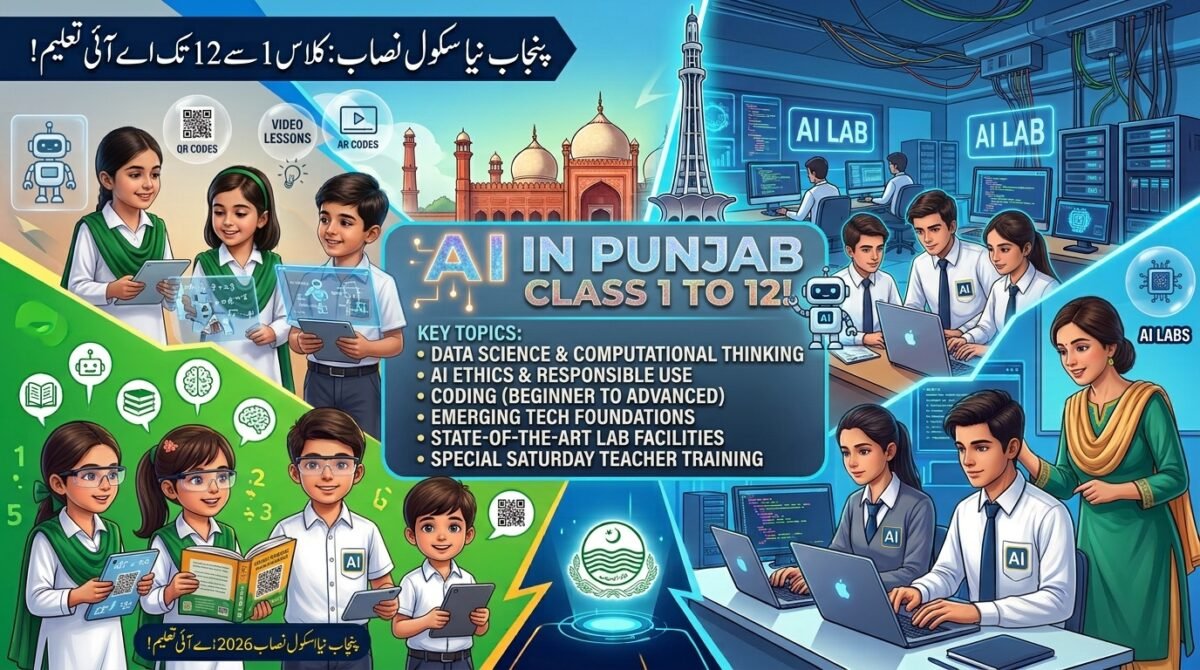
Punjab New School Curriculum 2026 is bringing an important change to the education system, with the Punjab government directing officials to develop an Artificial Intelligence (AI) curriculum from Class 1 to Class 12. The move is part of a wider effort to improve digital literacy, modernise education and prepare students for future careers.
For students and parents, this development is important because AI is expected to become a more regular part of school education in Punjab. Along with AI education, the province is also working on a revised curriculum that aims to reduce textbook burden and move students away from rote memorisation.
Punjab New School Curriculum 2026: What Has Changed?
On September 24, 2026, Punjab Chief Minister Maryam Nawaz approved the new school curriculum and directed officials to include Artificial Intelligence from Class 1 to Class 12.
The government has also called for the establishment of AI and computer laboratories alongside the new curriculum. The aim is not only to teach students about technology but also to improve their digital literacy and educational foundations.
This means AI education is being planned as a long-term part of schooling rather than something limited to university-level students.
AI From Class 1 to 12 in Punjab
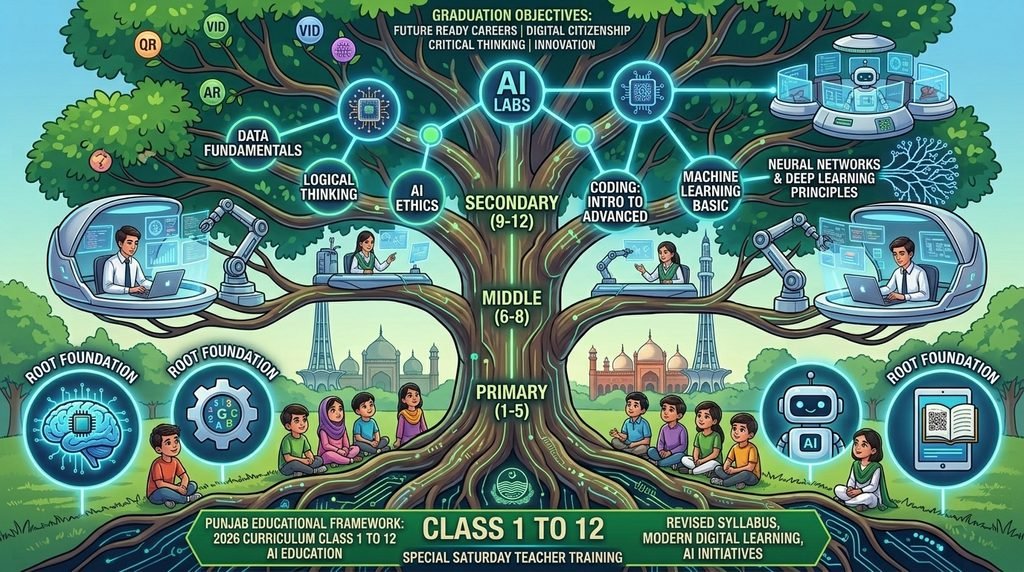
One of the biggest highlights of the Punjab education reforms is the planned AI curriculum for students from Grade 1 through Grade 12.
The exact topics and detailed syllabus for every class have not yet been publicly finalised. Therefore, students and parents should not assume that Class 1 students will study advanced programming or complicated AI systems.
Instead, AI education can be expected to become progressively more advanced as students move through higher grades.
For younger students, lessons may focus on basic digital awareness and understanding technology. At higher levels, students can gradually move toward areas such as computational thinking, data, responsible use of AI, coding and emerging technologies.
Important: The government has directed officials to finalise the AI curriculum, so the detailed class-wise syllabus should be checked when the official curriculum is released.
New Curriculum to Reduce Textbook Burden
Another major feature of Punjab’s new curriculum is the effort to reduce the burden of textbooks.
According to officials, the revised curriculum for ECCE to Grade 5 is designed to reduce textbook volume by around 25% and place greater emphasis on learning outcomes rather than memorisation.
This could make learning easier for younger students because the focus will increasingly be on understanding concepts instead of simply memorising long answers.
The revised books are planned to be available for the new academic session beginning in April 2027.
QR Codes and Video Lessons in Textbooks
Punjab’s new curriculum also has a digital learning component.
According to the reported plan, new textbooks will contain QR codes that students can scan to access video lessons related to the topics in their books.
This can provide students with another way to understand difficult topics.
For example, instead of reading only a written explanation of a science concept, a student could potentially use the QR code to access a related video lesson.
This approach could be especially useful for students who learn better through visual and digital resources.
What Will Happen to Teachers?
Curriculum reform also requires teachers to learn how to teach the new material.
Officials have said that teachers will receive training for the revised syllabus. Cambridge officials involved in assessing the curriculum are also expected to provide teacher training.
The Punjab government has additionally discussed dedicating Saturdays to teachers’ training across the province.
This is important because simply changing textbooks is not enough. Teachers need appropriate training to help students understand new concepts effectively.
AI Labs and Computer Labs in Schools
The Punjab government has also stressed the development of computer laboratories alongside the new curriculum.
The purpose of these labs would be to give students opportunities to develop practical digital skills rather than learning technology only from textbooks.
For students, access to computer facilities could become increasingly important as AI and digital education become part of the school system.
However, the availability and implementation of these facilities may differ between schools, so parents should follow announcements from their school and the Punjab School Education Department.
What Does the New Curriculum Mean for Students?
The new curriculum could bring several changes to students’ learning experience.
1. More Digital Learning
Students are likely to encounter more digital resources, including video lessons and technology-based learning.
2. Introduction to AI
AI is planned to become part of education from Class 1 to Class 12, with the content expected to become more advanced at higher levels.
3. Less Focus on Rote Learning
The revised curriculum aims to improve learning outcomes and reduce excessive memorisation.
4. More Practical Skills
Computer and AI education can help students develop skills that may become useful in higher education and future careers.
5. Better Digital Literacy
Students will need to understand not only how to use technology but also how to use emerging technologies responsibly.
What Should Parents Know?
Parents should understand that the announcement does not mean that every child will immediately start studying advanced AI.
The government has directed the relevant authorities to finalise the AI curriculum. The detailed content, textbooks and implementation process will determine exactly what students study in each grade.
Parents should therefore avoid relying on unofficial social-media posts claiming that a specific AI syllabus has already been introduced unless the information comes from an official education authority.
Parents can, however, encourage children to develop basic digital skills and a positive attitude toward technology.
When Will the New Curriculum Start?
The revised ECCE to Grade 5 curriculum is planned for the academic session beginning in April 2027. Officials said Cambridge’s final content input is expected in December 2026, followed by textbook printing from January.
The AI curriculum for Class 1 to Class 12 is being finalised as part of the broader reform. Its detailed implementation schedule should become clearer once the official curriculum and related notifications are issued.
Why AI Education Is Important for Punjab Students
Artificial Intelligence is rapidly becoming part of education, business, technology and many professional fields.
Introducing AI concepts at school level can give students an early understanding of how modern technology works.
However, AI education should not replace fundamental subjects such as English, Mathematics, Science and Urdu. Instead, the goal should be to combine strong foundational education with modern digital skills.
This is particularly important for younger students, who first need strong reading, writing, mathematics and problem-solving abilities.
Mental Health and Other Education Reforms
Punjab’s new curriculum discussions are not limited to AI.
Officials have also discussed mental health training for teachers, online counselling facilities for students and the possibility of appointing visiting psychologists in districts. The government has also considered legislation against corporal punishment in schools.
These initiatives indicate that the education reforms are intended to address not only academic performance but also the wider school environment.
What Students Should Do Now
Students do not need to worry about learning advanced AI immediately.
Instead, they can focus on building strong foundations:
- Improve English and communication skills.
- Strengthen Mathematics and logical thinking.
- Learn basic computer skills.
- Develop problem-solving abilities.
- Use technology responsibly.
- Stay updated with official education announcements.
- Avoid believing unverified curriculum information on social media.
These skills can help students adapt when the detailed AI curriculum is implemented.
Conclusion
The Punjab New School Curriculum 2026 represents an important shift toward modern and technology-focused education. The government’s plan to introduce AI education from Class 1 to Class 12, develop computer and AI labs, reduce textbook burden and introduce QR-linked digital learning could significantly change how students learn in Punjab.
For parents and students, the most important point is that the detailed AI syllabus is still being finalised. The new curriculum for younger classes is planned for the April 2027 academic session, while further official details about AI implementation are expected as the process moves forward.
Students who build strong academic foundations along with digital and problem-solving skills will be better prepared for the changing education and employment landscape.


Leave a Reply