Category: Blog

Your blog category

  • HEC Scholarships 2026 for Pakistani Students – Complete Guide

    HEC Scholarships 2026 for Pakistani Students – Complete Guide

    Higher Education Commission (HEC) Pakistan offers multiple scholarship opportunities for talented students who want to continue their higher education in Pakistan and abroad. HEC Scholarships 2026 provide financial support for undergraduate, master’s, and PhD students through different national and international scholarship programs.

    Many Pakistani students face financial challenges while pursuing higher education. HEC scholarships help deserving students by covering tuition fees, living expenses, travel costs, and other educational expenses depending on the scholarship program.

    In this guide, we will explain the latest HEC Scholarships 2026, eligibility criteria, application process, required documents, and important tips to successfully apply.

    What Are HEC Scholarships 2026?

    HEC Scholarships 2026 are educational funding programs launched by the Higher Education Commission of Pakistan to support talented and deserving students. These scholarships are available for students who want to study at recognized universities in Pakistan or foreign countries.

    The main purpose of these scholarships is to improve access to quality education and develop skilled professionals in different fields including science, technology, medicine, engineering, business, and social sciences.

    Types of HEC Scholarships 2026

    HEC offers different categories of scholarships depending on students’ educational levels and study goals.

    1. HEC Undergraduate Scholarships

    These scholarships are designed for students who have completed intermediate education and want to pursue bachelor’s degrees.

    Benefits may include:

    • Tuition fee support
    • Monthly stipend
    • Book allowance
    • Other educational expenses

    2. HEC Master’s Scholarships

    Students who have completed bachelor’s degrees can apply for master’s scholarship programs.

    These scholarships support students in advanced studies and research fields.

    3. HEC PhD Scholarships

    HEC provides PhD scholarships for students who want to conduct advanced research in Pakistan or international universities.

    These programs aim to increase research quality and academic development.

    4. International Scholarships

    HEC also offers opportunities for Pakistani students to study abroad through partnerships with different countries and universities.

    Popular destinations may include:

    • China
    • UK
    • Germany
    • Turkey
    • Australia
    • Other partner countries

    Eligibility Criteria for HEC Scholarships 2026

    Eligibility requirements vary according to each scholarship program. However, common requirements include:

    Academic Qualification

    Applicants must have the required educational qualification according to the scholarship category.

    Examples:

    • Bachelor’s scholarship: Intermediate qualification
    • Master’s scholarship: Bachelor’s degree
    • PhD scholarship: Master’s/MPhil degree

    Minimum Academic Performance

    Most HEC scholarships require a specific minimum percentage or CGPA.

    Students with strong academic records usually have better chances of selection.

    Pakistani Nationality

    Applicants generally must be Pakistani citizens or residents according to the scholarship requirements.

    Age Limit

    Some scholarship programs have specific age restrictions. Students should check the official advertisement before applying.

    University Admission

    For many international scholarships, students may need admission confirmation from a recognized university.

    How to Apply for HEC Scholarships 2026?

    Students can apply for HEC scholarships through the official online portal.

    Follow these steps:

    Step 1: Visit HEC Scholarship Portal

    Create an account on the HEC online application system.

    Step 2: Complete Your Profile

    Provide accurate information including:

    • Personal details
    • Academic records
    • Contact information
    • Educational history

    Step 3: Select Available Scholarship

    Choose the scholarship program according to your qualification and career goals.

    Step 4: Upload Required Documents

    Applicants usually need:

    • CNIC/B-Form
    • Academic certificates
    • Transcripts
    • Passport (for international scholarships)
    • Domicile certificate
    • Research proposal (for research programs)
    • Other required documents

    Step 5: Submit Application

    Review all information carefully before final submission.

    Incomplete applications may be rejected.

    Required Documents for HEC Scholarships 2026

    Before applying, students should prepare the following documents:

    • CNIC or B-Form
    • Recent photographs
    • Educational certificates
    • Academic transcripts
    • Degree documents
    • Domicile certificate
    • Experience certificates (if required)
    • Recommendation letters (for some programs)
    • Statement of purpose
    • Research proposal (PhD applicants)

    Benefits of HEC Scholarships

    HEC scholarships provide several financial and academic benefits.

    Common benefits include:

    • Full or partial tuition fee coverage
    • Monthly stipend
    • Research funding
    • Travel allowance
    • Health insurance (for some international programs)
    • Accommodation support

    These benefits allow students to focus on their studies without financial pressure.

    Tips to Increase Your Chances of Selection

    Competition for HEC scholarships is high. Follow these tips:

    Maintain Good Academic Records

    A strong academic background improves your selection chances.

    Prepare a Strong Statement of Purpose

    Explain clearly:

    • Your academic goals
    • Career plans
    • Reasons for choosing the field

    Apply Before Deadline

    Avoid submitting applications at the last moment.

    Technical issues can delay submission.

    Check Eligibility Carefully

    Apply only for scholarships where you meet all requirements.

    Improve English Skills

    Many international scholarships require English proficiency tests.

    Frequently Asked Questions (FAQs)

    What is the last date to apply for HEC Scholarships 2026?

    The deadline depends on the specific scholarship program. Students should check the official HEC announcement for updated dates.

    Are HEC scholarships fully funded?

    Some HEC scholarships are fully funded, while others provide partial financial support depending on the program.

    Can intermediate students apply for HEC scholarships?

    Yes, some undergraduate scholarship programs are available for students after intermediate education.

    How can I apply for HEC scholarships online?

    Students can apply through the official HEC online scholarship portal by creating an account and submitting the required documents.

    Are HEC scholarships available for studying abroad?

    Yes, HEC offers various international scholarship programs for Pakistani students.

    Conclusion

    HEC Scholarships 2026 are excellent opportunities for Pakistani students who want to achieve higher education goals without financial barriers. Whether you want to study in Pakistan or abroad, these scholarships can provide valuable financial and academic support.

    Students should regularly check HEC announcements, prepare required documents early, and submit applications before deadlines to increase their chances of success.


  • CM Punjab Education Initiatives 2026: Scholarships, Schools & Digital Learning Programs

    CM Punjab Education Initiatives 2026: Scholarships, Schools & Digital Learning Programs

    Education plays a vital role in the development of any society. To improve learning opportunities and provide better facilities to students, the Punjab government has introduced several education initiatives focusing on schools, scholarships, digital learning, teacher development, and student support programs.

    The CM Punjab Education Initiatives 2026 aim to create a modern education system where students from different backgrounds can access quality learning opportunities. These programs focus on improving government schools, supporting talented students, introducing technology-based education, and creating a better learning environment.

    Punjab’s education sector has seen increasing attention toward digital transformation, improved classroom facilities, and skill-based learning approaches.

    What Are CM Punjab Education Initiatives?

    CM Punjab Education Initiatives are government programs designed to improve the quality of education across Punjab. These initiatives focus on solving major challenges faced by students, including financial difficulties, lack of modern facilities, limited learning resources, and unequal educational opportunities.

    The main objectives of these programs include:

    • Providing financial support to deserving students
    • Improving government school infrastructure
    • Promoting digital education
    • Enhancing teaching quality
    • Encouraging skill development
    • Increasing access to quality education

    These reforms are designed to support students from primary level to higher education.

    1. CM Punjab Scholarship Programs for Students

    One of the major areas of focus is providing scholarships to talented and deserving students. Many students leave their education because of financial problems, especially at higher education levels.

    Scholarship programs help students continue their studies by reducing their financial burden.

    These programs generally support students through:

    • Tuition fee assistance
    • Merit-based scholarships
    • Financial aid for talented students
    • Support for higher education

    The aim is to ensure that hardworking students do not have to stop their education due to financial limitations.

    2. Digital Learning and Smart Education System

    Technology has changed the way students learn. The Punjab government has focused on introducing digital learning methods in educational institutions.

    Digital education initiatives include:

    • Smart classrooms
    • Digital learning resources
    • Online educational content
    • Technology-based teaching methods

    Smart classrooms help students understand difficult concepts through videos, interactive lessons, and modern teaching techniques.

    The expansion of smart classrooms has been highlighted as part of Punjab’s education modernization efforts.

    3. Improvement of Government Schools

    Government schools provide education to millions of students across Punjab. Improving these schools is one of the important goals of education reforms.

    The government focuses on:

    • Better classroom environments
    • Improved facilities
    • Clean learning spaces
    • Modern educational resources

    A better school environment encourages students to attend classes regularly and improves their learning experience.

    4. Teacher Training and Professional Development

    Teachers are the foundation of the education system. Without skilled teachers, improving education quality is difficult.

    CM Punjab education programs focus on:

    • Teacher training workshops
    • Modern teaching methods
    • Digital teaching skills
    • Better classroom management techniques

    Training programs help teachers adopt new educational approaches and provide better guidance to students.

    Recent education reforms have also emphasized moving toward more interactive and student-focused learning methods.

    5. Support Programs for Deserving Students

    Many students in Punjab have talent but lack resources. Student support programs aim to provide opportunities to those who need assistance.

    These programs may include:

    • Educational assistance
    • Learning resources
    • Career guidance
    • Skill development opportunities

    The goal is to create equal opportunities so that students from rural and urban areas can progress.

    6. Focus on Skill Development and Future Careers

    Modern education is not only about textbooks. Students need practical skills that help them succeed in professional life.

    CM Punjab education initiatives encourage:

    • Technical education
    • Digital skills
    • Career-focused learning
    • Professional training

    These programs help students prepare for future job markets and emerging industries.

    7. Modern Curriculum and Better Learning Methods

    Education systems need continuous improvement according to changing times.

    Modern curriculum improvements focus on:

    • Practical learning
    • Critical thinking
    • Creativity
    • Technology awareness

    The purpose is to move students beyond traditional memorization and encourage understanding-based learning.

    8. Benefits of CM Punjab Education Initiatives for Students

    These education programs provide several benefits:

    Better Learning Opportunities

    Students get access to improved facilities and modern learning resources.

    Financial Support

    Scholarships and assistance programs help students continue education.

    Digital Skills

    Technology-based learning prepares students for future careers.

    Improved Teaching Quality

    Teacher training improves classroom experiences.

    Equal Education Access

    Students from different backgrounds get better opportunities.

    How Students Can Get Information About Punjab Education Programs

    Students should regularly check official education portals and announcements for:

    • Scholarship updates
    • Admission information
    • School programs
    • Educational schemes
    • Application deadlines

    Keeping updated helps students apply for opportunities at the right time.

    Future of Education in Punjab

    The future of education depends on technology, innovation, and equal opportunities. CM Punjab Education Initiatives represent efforts toward building a stronger education system where students can learn with better resources.

    With improvements in digital learning, scholarships, school facilities, and teacher development, Punjab’s education sector is moving toward a more modern approach.

    Conclusion

    The CM Punjab Education Initiatives 2026 provide important opportunities for students through scholarships, digital education, school improvements, and skill development programs.

    These initiatives aim to make education more accessible, modern, and student-friendly. For students and parents, staying informed about these programs can help them benefit from available educational opportunities.

    A strong education system creates a stronger future, and continuous reforms can help Punjab develop a generation of skilled and educated young people.

  • Punjab New School Curriculum 2026: AI From Class 1 to 12 – Complete Guide for Students & Parents

    Punjab New School Curriculum 2026: AI From Class 1 to 12 – Complete Guide for Students & Parents

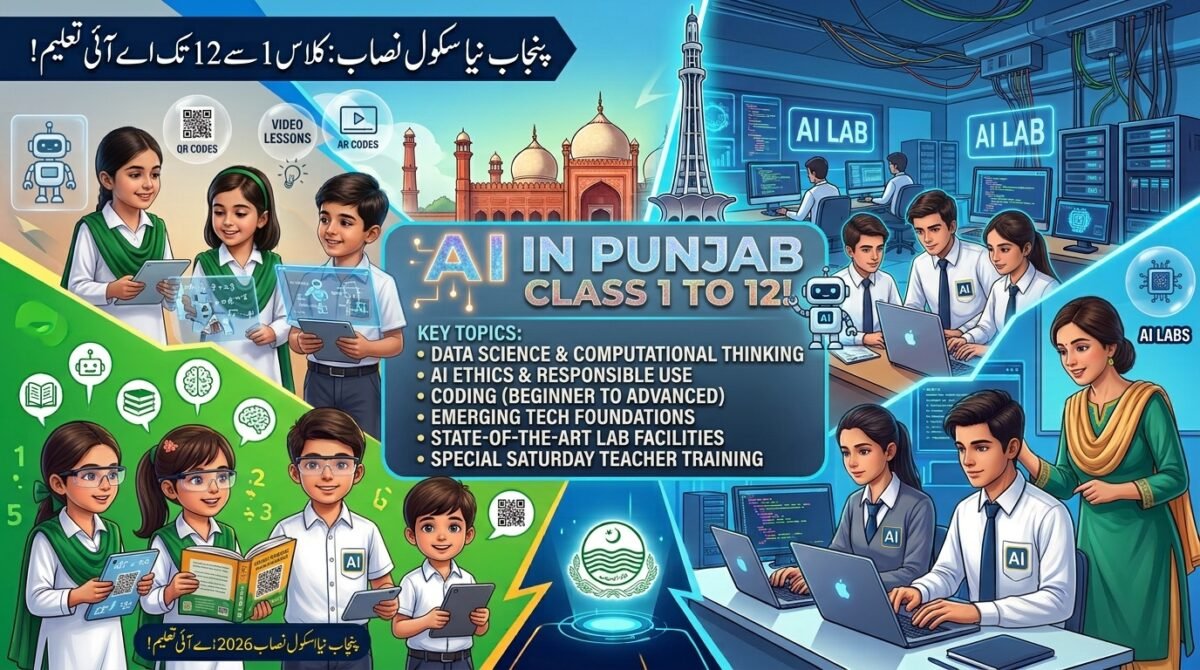
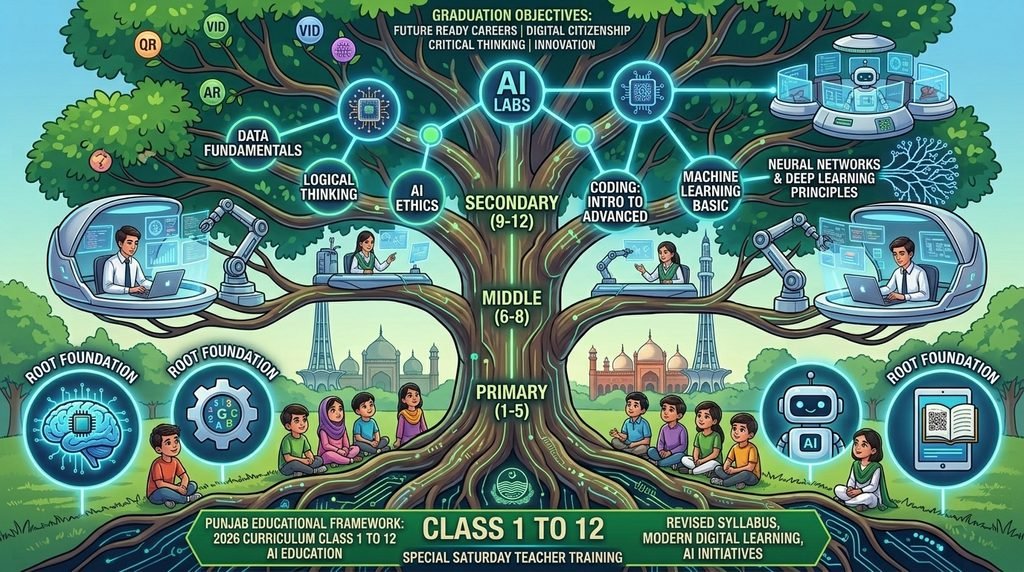
    Punjab New School Curriculum 2026 is bringing an important change to the education system, with the Punjab government directing officials to develop an Artificial Intelligence (AI) curriculum from Class 1 to Class 12. The move is part of a wider effort to improve digital literacy, modernise education and prepare students for future careers.

    For students and parents, this development is important because AI is expected to become a more regular part of school education in Punjab. Along with AI education, the province is also working on a revised curriculum that aims to reduce textbook burden and move students away from rote memorisation.

    Punjab New School Curriculum 2026: What Has Changed?

    On September 24, 2026, Punjab Chief Minister Maryam Nawaz approved the new school curriculum and directed officials to include Artificial Intelligence from Class 1 to Class 12.

    The government has also called for the establishment of AI and computer laboratories alongside the new curriculum. The aim is not only to teach students about technology but also to improve their digital literacy and educational foundations.

    This means AI education is being planned as a long-term part of schooling rather than something limited to university-level students.

    AI From Class 1 to 12 in Punjab

    One of the biggest highlights of the Punjab education reforms is the planned AI curriculum for students from Grade 1 through Grade 12.

    The exact topics and detailed syllabus for every class have not yet been publicly finalised. Therefore, students and parents should not assume that Class 1 students will study advanced programming or complicated AI systems.

    Instead, AI education can be expected to become progressively more advanced as students move through higher grades.

    For younger students, lessons may focus on basic digital awareness and understanding technology. At higher levels, students can gradually move toward areas such as computational thinking, data, responsible use of AI, coding and emerging technologies.

    Important: The government has directed officials to finalise the AI curriculum, so the detailed class-wise syllabus should be checked when the official curriculum is released.

    New Curriculum to Reduce Textbook Burden

    Another major feature of Punjab’s new curriculum is the effort to reduce the burden of textbooks.

    According to officials, the revised curriculum for ECCE to Grade 5 is designed to reduce textbook volume by around 25% and place greater emphasis on learning outcomes rather than memorisation.

    This could make learning easier for younger students because the focus will increasingly be on understanding concepts instead of simply memorising long answers.

    The revised books are planned to be available for the new academic session beginning in April 2027.

    QR Codes and Video Lessons in Textbooks

    Punjab’s new curriculum also has a digital learning component.

    According to the reported plan, new textbooks will contain QR codes that students can scan to access video lessons related to the topics in their books.

    This can provide students with another way to understand difficult topics.

    For example, instead of reading only a written explanation of a science concept, a student could potentially use the QR code to access a related video lesson.

    This approach could be especially useful for students who learn better through visual and digital resources.

    What Will Happen to Teachers?

    Curriculum reform also requires teachers to learn how to teach the new material.

    Officials have said that teachers will receive training for the revised syllabus. Cambridge officials involved in assessing the curriculum are also expected to provide teacher training.

    The Punjab government has additionally discussed dedicating Saturdays to teachers’ training across the province.

    This is important because simply changing textbooks is not enough. Teachers need appropriate training to help students understand new concepts effectively.

    AI Labs and Computer Labs in Schools

    The Punjab government has also stressed the development of computer laboratories alongside the new curriculum.

    The purpose of these labs would be to give students opportunities to develop practical digital skills rather than learning technology only from textbooks.

    For students, access to computer facilities could become increasingly important as AI and digital education become part of the school system.

    However, the availability and implementation of these facilities may differ between schools, so parents should follow announcements from their school and the Punjab School Education Department.

    What Does the New Curriculum Mean for Students?

    The new curriculum could bring several changes to students’ learning experience.

    1. More Digital Learning

    Students are likely to encounter more digital resources, including video lessons and technology-based learning.

    2. Introduction to AI

    AI is planned to become part of education from Class 1 to Class 12, with the content expected to become more advanced at higher levels.

    3. Less Focus on Rote Learning

    The revised curriculum aims to improve learning outcomes and reduce excessive memorisation.

    4. More Practical Skills

    Computer and AI education can help students develop skills that may become useful in higher education and future careers.

    5. Better Digital Literacy

    Students will need to understand not only how to use technology but also how to use emerging technologies responsibly.

    What Should Parents Know?

    Parents should understand that the announcement does not mean that every child will immediately start studying advanced AI.

    The government has directed the relevant authorities to finalise the AI curriculum. The detailed content, textbooks and implementation process will determine exactly what students study in each grade.

    Parents should therefore avoid relying on unofficial social-media posts claiming that a specific AI syllabus has already been introduced unless the information comes from an official education authority.

    Parents can, however, encourage children to develop basic digital skills and a positive attitude toward technology.

    When Will the New Curriculum Start?

    The revised ECCE to Grade 5 curriculum is planned for the academic session beginning in April 2027. Officials said Cambridge’s final content input is expected in December 2026, followed by textbook printing from January.

    The AI curriculum for Class 1 to Class 12 is being finalised as part of the broader reform. Its detailed implementation schedule should become clearer once the official curriculum and related notifications are issued.

    Why AI Education Is Important for Punjab Students

    Artificial Intelligence is rapidly becoming part of education, business, technology and many professional fields.

    Introducing AI concepts at school level can give students an early understanding of how modern technology works.

    However, AI education should not replace fundamental subjects such as English, Mathematics, Science and Urdu. Instead, the goal should be to combine strong foundational education with modern digital skills.

    This is particularly important for younger students, who first need strong reading, writing, mathematics and problem-solving abilities.

    Mental Health and Other Education Reforms

    Punjab’s new curriculum discussions are not limited to AI.

    Officials have also discussed mental health training for teachers, online counselling facilities for students and the possibility of appointing visiting psychologists in districts. The government has also considered legislation against corporal punishment in schools.

    These initiatives indicate that the education reforms are intended to address not only academic performance but also the wider school environment.

    What Students Should Do Now

    Students do not need to worry about learning advanced AI immediately.

    Instead, they can focus on building strong foundations:

    • Improve English and communication skills.
    • Strengthen Mathematics and logical thinking.
    • Learn basic computer skills.
    • Develop problem-solving abilities.
    • Use technology responsibly.
    • Stay updated with official education announcements.
    • Avoid believing unverified curriculum information on social media.

    These skills can help students adapt when the detailed AI curriculum is implemented.

    Conclusion

    The Punjab New School Curriculum 2026 represents an important shift toward modern and technology-focused education. The government’s plan to introduce AI education from Class 1 to Class 12, develop computer and AI labs, reduce textbook burden and introduce QR-linked digital learning could significantly change how students learn in Punjab.

    For parents and students, the most important point is that the detailed AI syllabus is still being finalised. The new curriculum for younger classes is planned for the April 2027 academic session, while further official details about AI implementation are expected as the process moves forward.

    Students who build strong academic foundations along with digital and problem-solving skills will be better prepared for the changing education and employment landscape.

  • CM Punjab E-Bike Scheme Phase 2 2026: Essential Student Guide, Eligibility & Easy Online Registration

    CM Punjab E-Bike Scheme Phase 2 2026: Essential Student Guide, Eligibility & Easy Online Registration

    CM Punjab E-Bike Scheme Phase 2 2026

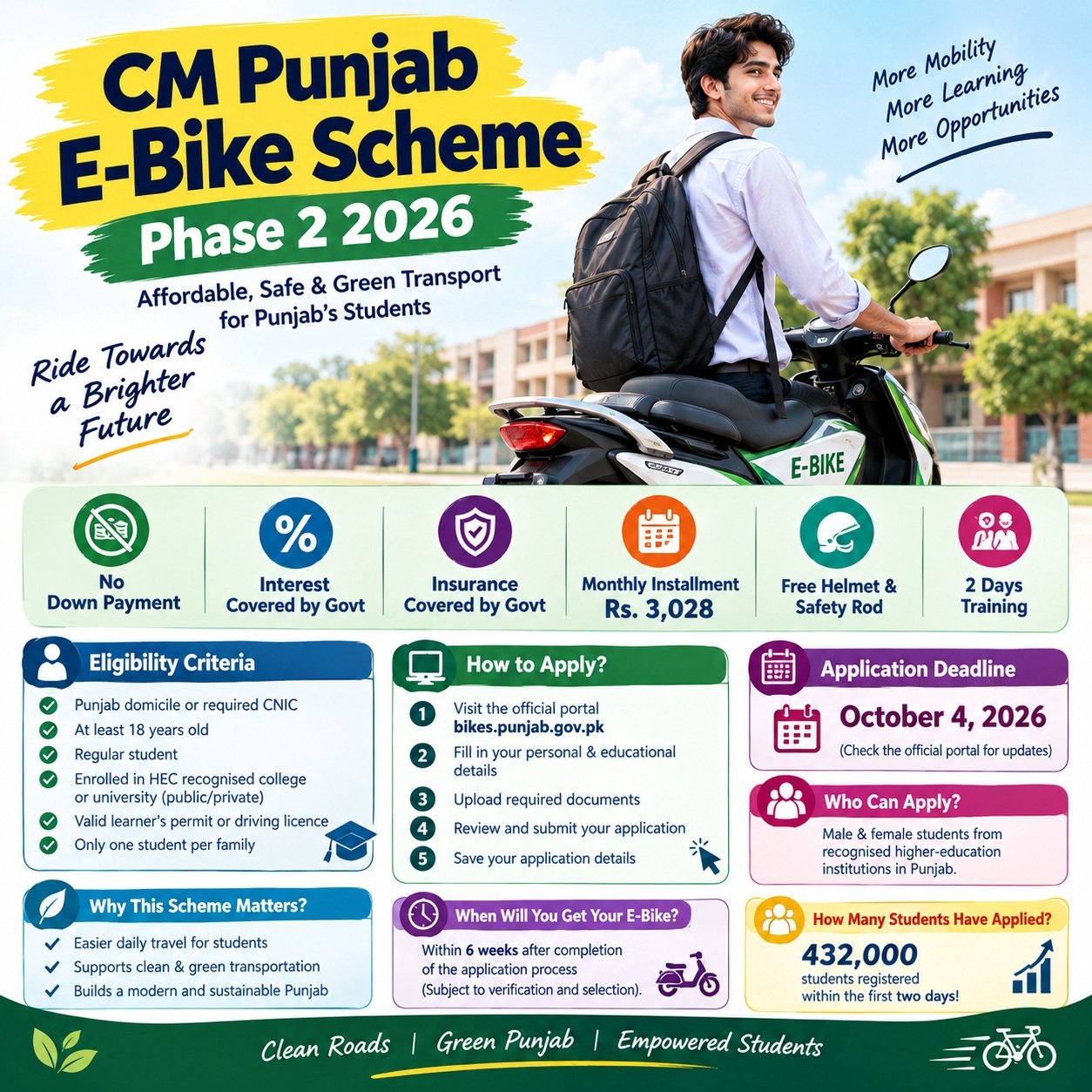
    The CM Punjab E-Bike Scheme Phase 2 2026 has been launched to help students in Punjab access affordable and environmentally friendly transportation. The second phase is being implemented under the Punjab government’s student-focused initiatives and is open to eligible male and female students enrolled in recognised higher-education institutions.

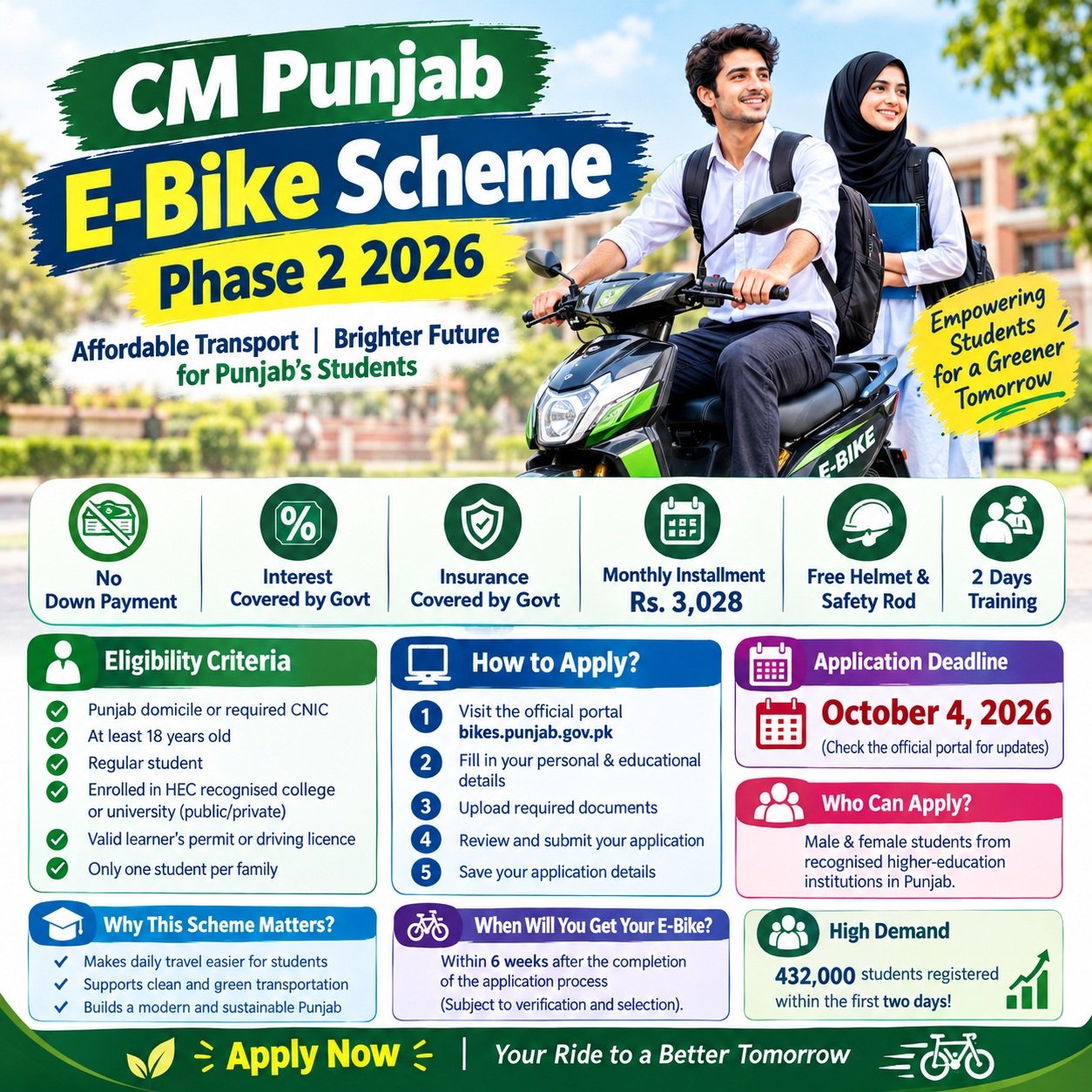
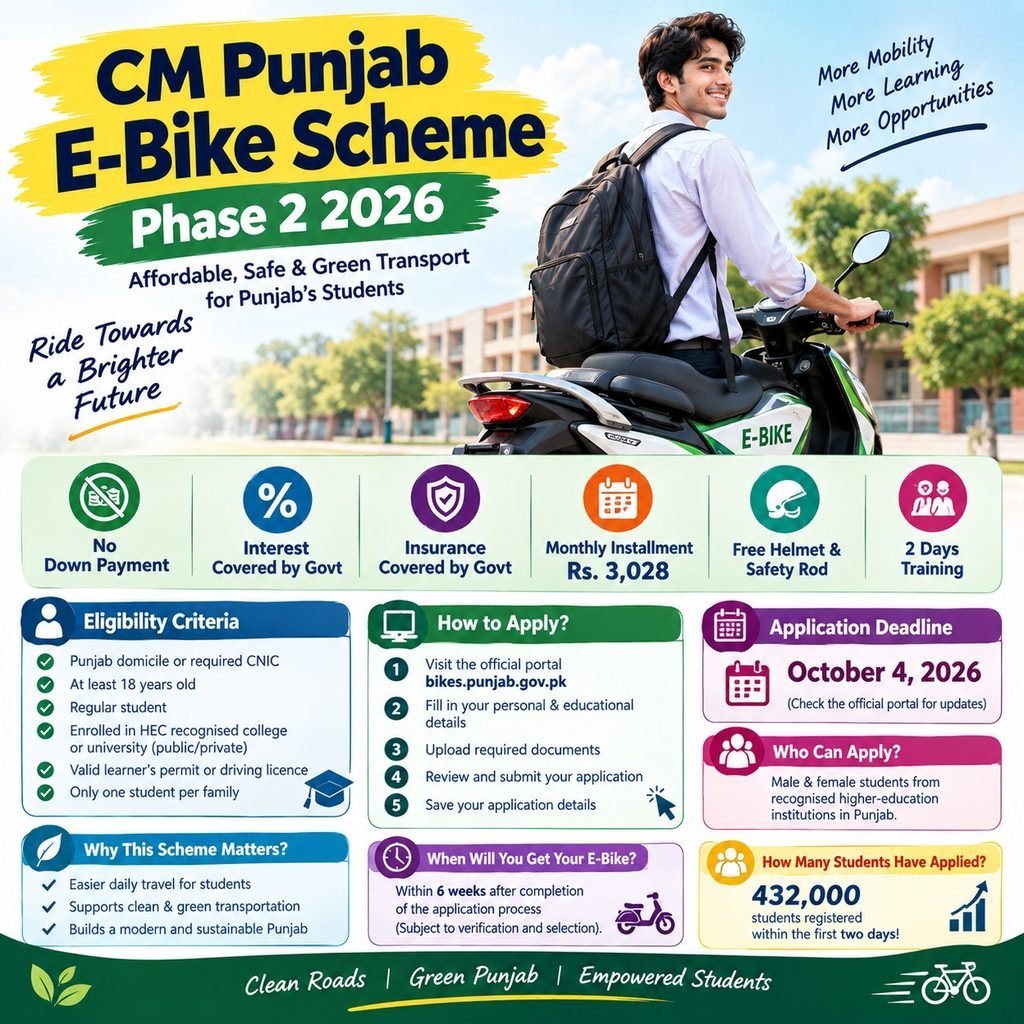
    The scheme has attracted significant interest from students across the province. According to reports published after the launch, around 432,000 students registered within the first two days, showing strong demand for affordable transportation among students.

    Under the latest arrangement, eligible students do not have to make a down payment. The Punjab government will cover the interest and insurance costs, while successful applicants will pay a monthly installment. Students will also receive safety equipment and training.

    This article explains the latest information about the CM Punjab E-Bike Scheme Phase 2 2026, including eligibility, registration, installment details, deadline, required conditions and other important information.

    What Is the CM Punjab E-Bike Scheme Phase 2 2026?

    The CM Punjab E-Bike Scheme is a transportation initiative designed to make it easier for students to travel between their homes and educational institutions.

    Phase II was formally launched in September 2026. The Punjab government has expanded the programme and made changes to the financial arrangement, including removing the upfront down-payment requirement for students.

    The programme is focused on students studying in recognised colleges and universities in Punjab. Both male and female students can apply if they meet the published eligibility requirements.

    The Punjab Transport Department describes the wider initiative as an effort to address students’ mobility needs while supporting cleaner transportation.

    Who Can Apply for the CM Punjab E-Bike Scheme?

    Students must meet specific conditions to apply for Phase II.

    According to the latest published eligibility information, applicants must:

    • Have a Punjab domicile or CNIC/identity documentation as required by the scheme.
    • Be at least 18 years old.
    • Be a regular student.
    • Be enrolled in a public or private degree college or university recognised by HEC.
    • Have either a learner’s permit or a valid motorcycle driving licence.
    • Only one student per family can receive an e-bike under the scheme.

    Students should carefully check their information before submitting an application because incorrect personal, educational or identification details can create problems during verification.

    How Much Will Students Pay?

    One of the major changes in Phase II is the removal of the down payment.

    Under the latest reported arrangement:

    Down payment: No down payment
    Interest: Paid by the Punjab government
    Insurance: Paid by the Punjab government
    Monthly installment: Rs. 3,028
    Safety equipment: Helmet and safety rod provided
    Training: Two days of training for selected students

    The exact financial obligations should always be checked against the official scheme information and the terms presented during the application and financing process.

    Is the E-Bike Interest-Free?

    The student financing arrangement has been described as interest-free because the Punjab government will bear the interest costs associated with the scheme.

    This means eligible students are not expected to pay a separate interest amount under the announced arrangement. The government is also covering insurance costs.

    Students should nevertheless read the final financing documents carefully before accepting the bike because the agreement contains the applicable repayment terms.

    What Safety Equipment Will Students Receive?

    The scheme includes safety-related support for successful applicants.

    Each selected student will receive:

    • A helmet
    • A safety rod
    • Two days of training

    The training is intended to help students understand the safe operation of their electric bikes before using them regularly.

    Students should also follow traffic laws, use appropriate safety equipment and obtain the required licence or learner permit.

    What Is the Application Deadline?

    According to the latest information available from reports citing the Punjab Transport Department, students can submit applications for Phase II through the official scheme portal until October 4, 2026.

    Because application deadlines can change, students should check the official portal before submitting their application.

    The scheme’s reported portal is:

    Punjab E-Bike Scheme Official Portal

    How to Apply for CM Punjab E-Bike Scheme Phase 2?

    Eligible students can apply online through the Punjab E-Bike Scheme portal.

    The general application process involves providing personal and educational information and completing the required verification details.

    Students should have their relevant information ready before starting the application. This can include identification details, educational information, contact information and driving-related documentation.

    After completing the application, students should carefully review all information before final submission.

    It is important to save or note the application details for future reference.

    How Many Students Have Applied?

    The scheme received a very large response shortly after registration opened.

    Reports on September 10 and 11 said that approximately 432,000 students had registered within the first two days. Around 265,000 students were still completing their applications at that point, while more than 108,000 applications had been formally submitted.

    These figures refer to the early stage of the application process and can change as students complete, submit or update their applications.

    When Will Students Receive Their E-Bikes?

    Punjab Chief Minister Maryam Nawaz directed the relevant authorities to work toward delivering e-bikes within six weeks after completion of the application process.

    However, students should understand that the six-week direction does not necessarily mean every applicant will receive a bike on the same date.

    The final delivery process can depend on application verification, selection, financing formalities and other administrative requirements.

    Can Every Applicant Get an E-Bike?

    Registration does not automatically mean that every person who registers will receive an e-bike.

    Students must meet the eligibility requirements and complete the required application and verification process. The scheme also has a limited number of bikes, meaning applicants should wait for the official selection or financing outcome.

    Students should therefore keep their application information safe and regularly check official updates instead of relying on unofficial social media posts.

    Why Is the E-Bike Scheme Important for Students?

    Transportation can be a significant challenge for students who travel long distances to colleges and universities.

    An affordable electric bike can potentially make daily travel more manageable for eligible students. The programme also supports the use of electric transportation rather than conventional petrol-powered motorcycles.

    The Punjab government has separately announced plans to expand electric public transport across the province. In September 2026, the government announced a target of 3,000 electric buses by June 2027, with free travel on the announced service for students, women, senior citizens and persons with special needs.

    These initiatives indicate a broader expansion of electric transportation in Punjab.

    Important Points Students Should Remember

    Before applying for the E-Bike Scheme 2026, students should remember these key points:

    1. The applicant must meet the age requirement.
    2. The applicant must be a regular student at an eligible HEC-recognised institution.
    3. A Punjab domicile or required identity documentation is necessary.
    4. A learner’s permit or motorcycle driving licence is required.
    5. Only one student per family can receive an e-bike.
    6. No down payment is required under the latest announced arrangement.
    7. The Punjab government is covering interest and insurance costs.
    8. The reported monthly installment is Rs. 3,028.
    9. Selected students receive safety equipment and training.
    10. The reported application deadline is October 4, 2026.

    Conclusion

    This is a major student transportation initiative that aims to provide eligible students with access to electric bikes through a subsidised financing arrangement.

    The latest announced terms include no down payment, government-paid interest and insurance, a reported monthly installment of Rs. 3,028, free safety equipment and two days of training.

    Students interested in the programme should verify their eligibility and submit their application before the published deadline. They should also rely on the official Punjab E-Bike Scheme portal for application status and further instructions.